
August 2020 Cyber Funding & M&A Brief
Published by Pinpoint Search Group — the cybersecurity executive search firm that tracks every disclosed vendor funding round and acquisition in the sector.
At a glance
Get the full August 2020 dataset — every named company, round, investor, and segment.
What August told us
August 2020 carried a heavier strategic-buyer column than July alongside a return to mid-band funded volume — twenty-two transactions across eighteen funded rounds and four acquisitions, with $683.4M in disclosed funding and $1.04B in disclosed M&A. The funded side ran almost double July's reading, and the M&A column produced two nine-figure cyber acquisitions: Fastly's $775M purchase of Signal Sciences in API and Palo Alto Networks's $265M acquisition of The Crypsis Group in Forensics. Signal Sciences is the only API-segment M&A event the workbook tracks through August 2020.
Funded activity was led by ReliaQuest's $300M growth round in XDR — the largest XDR-segment funded reading the workbook has tracked so far and one of the larger growth-stage cyber rounds across the data set's opening four months. Sumo Logic's $100M IPO in Threat Intel followed, the workbook's first IPO transaction. Keeper Security at $60M growth funding in Identity, Perimeter 81 at $40M Series B in SASE, SpyCloud at $30M Series C in Identity, and Silverfort at $30M Series B in Identity rounded out the named cohort. Identity is the densest segment of the month on the funded side — four funded rounds in total when the smaller Berbix Series A is included — and three of the four cleared at $30M-plus scale, a concentration the workbook had not previously tracked inside a single segment in a single month.
The Fastly/Signal Sciences transaction sits in a structurally distinct part of the buyer cohort from the workbook's prior strategic acquisitions: Fastly is an edge-compute and content-delivery vendor rather than a pure cyber security vendor, making this the workbook's first cyber-adjacent (rather than cyber-to-cyber or hyperscaler) strategic acquisition. Palo Alto Networks's $265M pickup of The Crypsis Group in Forensics is, by contrast, a pure-cyber-to-cyber tuck-in — extending Palo Alto's incident-response and forensics capabilities into its existing security portfolio. Two priced cyber acquisitions inside a single month, drawn from two structurally distinct buyer types (cyber-adjacent edge platform and pure-cyber strategic), sit alongside the buyer-diversity pattern the workbook has tracked since June and confirm that the strategic-buyer column is drawing repeat activity across multiple acquirer categories at the data set's outset.
Stage and segment breakdown
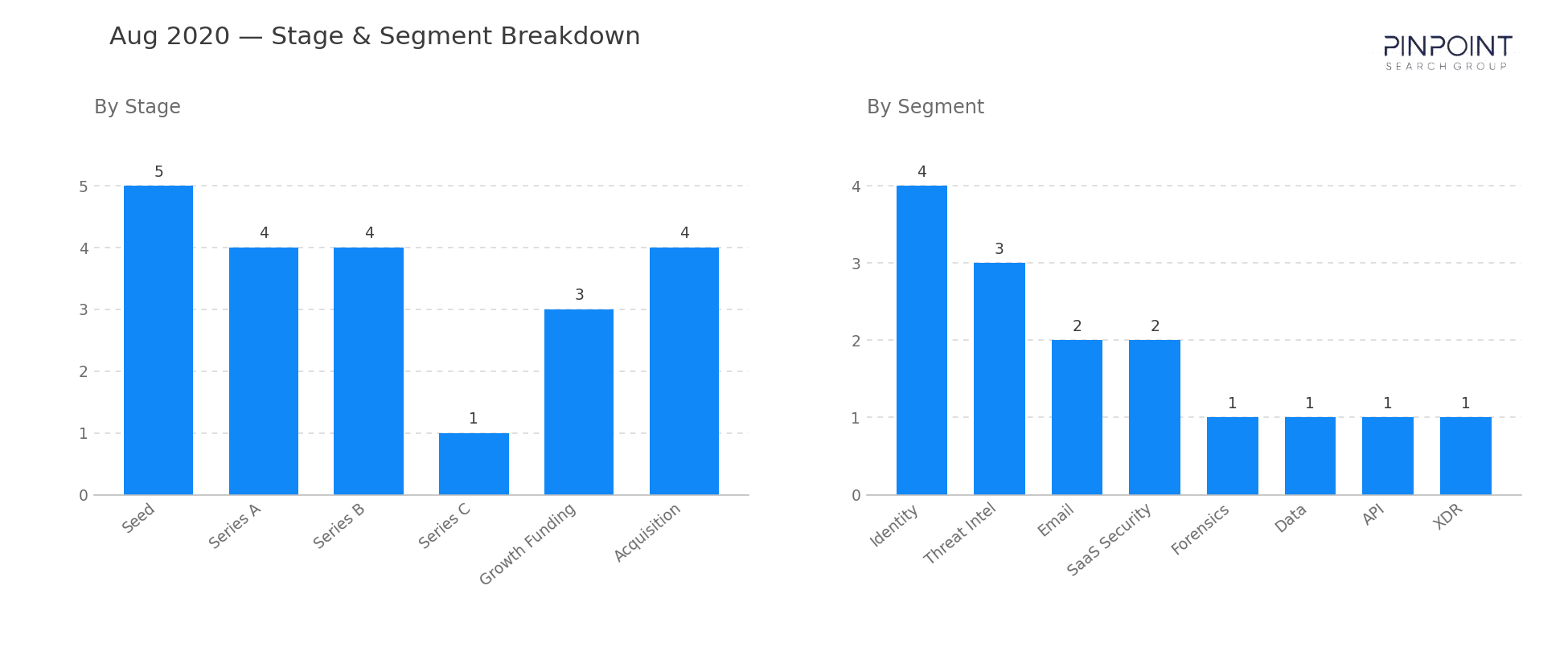
| Stage | Count |
|---|---|
| Seed | 5 |
| Series A | 4 |
| Series B | 4 |
| Series C | 1 |
| Growth Funding | 3 |
| Acquisition | 4 |
| Top segments | Transactions |
|---|---|
| Identity | 4 |
| Threat Intel | 3 |
| 2 | |
| SaaS Security | 2 |
| Forensics | 1 |
| Data | 1 |
Two deals worth your attention
Fastly's $775M acquisition of Signal Sciences in API. Fastly acquired Signal Sciences at $775M in August, the largest disclosed M&A event of the month and the only API-segment M&A event the workbook tracks through this point. The deal sits in a structurally distinct buyer cohort from the workbook's prior strategic acquisitions — Fastly is an edge-compute and content-delivery vendor rather than a cyber security vendor, making this a cyber-adjacent rather than pure-cyber-to-cyber acquisition. Signal Sciences brought web-application-firewall and API protection capabilities into Fastly's edge platform, framing application-and-API security as an edge-infrastructure-adjacent capability rather than a security-platform-only category.
ReliaQuest — $300M growth round in XDR. ReliaQuest raised $300M in growth funding for its security-operations platform, the largest funded event of August and the largest XDR-segment funded reading the workbook has tracked so far. The round signaled that managed extended detection and response was clearing growth-scale capital at nine-figure size and confirmed the XDR category as a fundable growth-stage segment early in the workbook's coverage.
The other 20 transactions are in the data feed — including the 4 acquisitions whose values never hit the press. Get August's details and more →
Methodology
Every transaction in this brief was sourced from a primary public report and dedupe-checked against the master Pinpoint funding workbook, which now contains ~2,600 transactions back to May 2020. Funding totals reflect disclosed capital only; acquisition values are included where publicly available.
Each deal is classified against Pinpoint's normalized cybersecurity segment taxonomy — read directly off what the company says they protect and mapped to one of the canonical segments. The taxonomy has been maintained continuously since 2020 and currently covers roughly 55 segments. Identity, Data, Detection / Response, and Threat Intel have been tracked from the first month of the series; AppSec and GRC entered the following month; emergent categories (AI/LLM, Supply Chain, Quantum, Browser) are added when they first appear in vendor positioning. That normalization layer is what makes multi-year, cross-segment comparisons possible against an otherwise inconsistent vocabulary in the broader market.
About Pinpoint Search Group
Cybersecurity innovators work with Pinpoint Search Group to identify, attract, and land professionals that enable maturation, scale, and successful outcomes. As start-ups continue raising millions in funding and established vendors make acquisitions to round out their offerings, Pinpoint Search Group is keeping track.
Get the underlying data
The narrative above is the free version. The paid Pinpoint Cyber Funding Data feed gives you every named transaction, every disclosed investor, every segment classification — exportable, filterable, and updated as the deals close.