
December 2020 Cyber Funding & M&A Brief
Published by Pinpoint Search Group — the cybersecurity executive search firm that tracks every disclosed vendor funding round and acquisition in the sector.
At a glance
Get the full December 2020 dataset — every named company, round, investor, and segment.
What December told us
December 2020 closed the workbook's opening year with twenty-six transactions across sixteen funded rounds and ten acquisitions, $919.3M in disclosed funding, and $360M in disclosed M&A — anchored by Norton LifeLock's $360M acquisition of Avira in Endpoint, the second-largest Endpoint strategic acquisition of 2020 after Ivanti's September pickup of MobileIron at $872M. The funded column ran high on late-stage concentration, with only two of sixteen rounds at Seed or Series A — the lowest Seed/A absolute count the workbook tracks across any 2020 month.
OneTrust's $300M Series C in GRC led the funded side, the largest GRC-segment funded round the workbook tracks across the eight months of 2020 coverage. Dragos at $110M Series C in OT/ICS followed, returning to the funded column after the segment's June and July strategic-acquisition activity (Microsoft/CyberX and Advent/Forescout) and confirming that operational-technology security continued to draw growth-stage capital on the funded side alongside the M&A activity earlier in the year. Wiz's $100M Series A in Cloud brings a new segment classification into the Pinpoint taxonomy. Beyond Identity at $75M Series B in Identity, BigID at $70M Series D+ in Data, Orca Security at $55M Series B in Detection/Response, and At-Bay at $34M Series C in Cyber Insurance rounded out the named cohort.
Both Cloud (via Wiz) and Cyber Insurance (via At-Bay) enter the Pinpoint segment taxonomy this month. Wiz's $100M Series A is the workbook's first Cloud-segment transaction; the segment is added because the company's positioning — agentless cloud security posture management across multi-cloud estates — does not fit cleanly into AppSec or Detection/Response classifications. At-Bay's $34M Series C is the workbook's first Cyber Insurance-segment transaction, a structurally distinct category that intersects underwriting risk pricing with security telemetry and that the data set's earlier coverage did not yet include. The year closes at 202 transactions, $5.28B in disclosed funded capital, and $5.35B in disclosed M&A across fifteen priced acquisitions, with the workbook's full-year reference point now set against the eight-month opening period.
Stage and segment breakdown
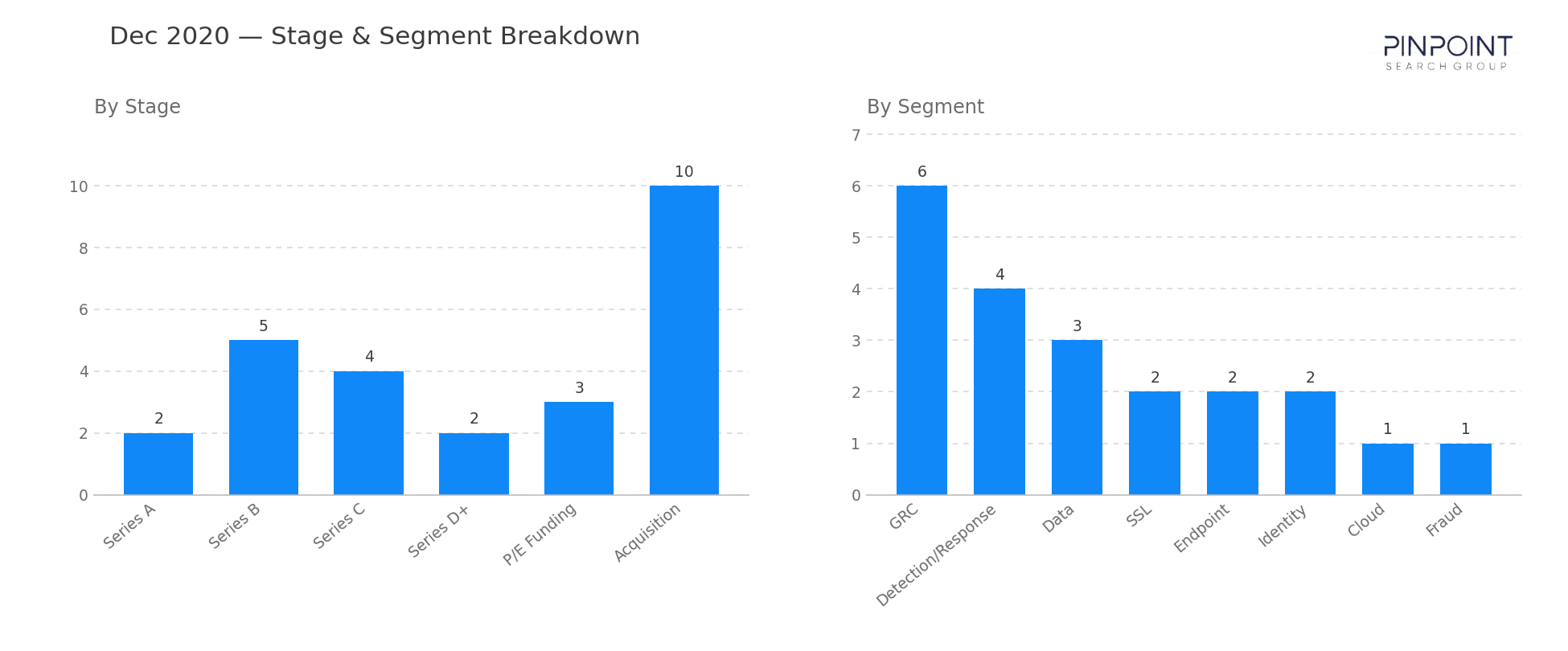
| Stage | Count |
|---|---|
| Series A | 2 |
| Series B | 5 |
| Series C | 4 |
| Series D+ | 2 |
| P/E Funding | 3 |
| Acquisition | 10 |
| Top segments | Transactions |
|---|---|
| GRC | 6 |
| Detection/Response | 4 |
| Data | 3 |
| SSL | 2 |
| Endpoint | 2 |
| Identity | 2 |
New segment in the taxonomy this month: "Cloud", "Cyber Insurance" enter the Pinpoint segment taxonomy for the first time in December 2020. Emergent categories are added when they first appear in vendor positioning; this is the first workbook event in this classification.
Two deals worth your attention
Norton LifeLock's $360M acquisition of Avira in Endpoint. Norton LifeLock acquired Avira at $360M in December, the largest disclosed M&A event of the month and the second-largest Endpoint strategic acquisition of 2020 after Ivanti's September pickup of MobileIron at $872M. Avira brought a European consumer antivirus and identity-protection business into Norton's consumer cyber platform, extending the buyer's geographic reach and product surface inside the consumer-protection category. The deal continues the year's Endpoint M&A thread — Ivanti/MobileIron in September and Norton/Avira in December — at the two highest disclosed M&A values of the segment in 2020.
Wiz — $100M Series A in Cloud. Wiz raised $100M Series A for its cloud security platform, the workbook's first Cloud-segment transaction and one of the larger Series A rounds the data set tracks in 2020. The round adds Cloud as a distinct classification in the Pinpoint taxonomy because the company's agentless multi-cloud-posture positioning does not fit cleanly into AppSec, Container, or Detection/Response categories. At nine-figure size at the Series A stage, the round signals strong investor conviction in cloud-native security as a standalone fundable category, even though the segment is brand-new in the data set this month.
Companies we've covered before
Orca Security first appeared in May 2020 with a $20M Series A in Detection/Response. The December 2020 $55M Series B is Orca's second tracked event — same segment classification, seven months apart, with a 2.75x step-up over the prior round. The exact-segment same-vendor repeat is one of the workbook's clearest single-segment ramps across the data set's opening year.
Salt Security first appeared in June 2020 with a $20M Series A in API. The December 2020 $30M Series B is Salt's second tracked event, same segment classification, six months apart, and a 1.5x step-up. The repeat positions Salt as one of two named API-segment vendors with multiple workbook events in 2020 (alongside the standalone Signal Sciences M&A event in August).
The other 24 transactions are in the data feed — including the 10 acquisitions whose values never hit the press. Get December's details and more →
Methodology
Every transaction in this brief was sourced from a primary public report and dedupe-checked against the master Pinpoint funding workbook, which now contains ~2,600 transactions back to May 2020. Funding totals reflect disclosed capital only; acquisition values are included where publicly available. Figures reflect the master workbook as of August 2026; counts may differ from the version originally published as the dataset is corrected.
Each deal is classified against Pinpoint's normalized cybersecurity segment taxonomy — read directly off what the company says they protect and mapped to one of the canonical segments. The taxonomy has been maintained continuously since 2020 and currently covers roughly 55 segments. Identity, Data, Detection / Response, and Threat Intel have been tracked from the first month of the series; AppSec and GRC entered the following month; emergent categories (AI/LLM, Supply Chain, Quantum, Browser) are added when they first appear in vendor positioning. That normalization layer is what makes multi-year, cross-segment comparisons possible against an otherwise inconsistent vocabulary in the broader market.
About Pinpoint Search Group
Cybersecurity innovators work with Pinpoint Search Group to identify, attract, and land professionals that enable maturation, scale, and successful outcomes. As start-ups continue raising millions in funding and established vendors make acquisitions to round out their offerings, Pinpoint Search Group is keeping track.
Get the underlying data
The narrative above is the free version. The paid Pinpoint Cyber Funding Data feed gives you every named transaction, every disclosed investor, every segment classification — exportable, filterable, and updated as the deals close.